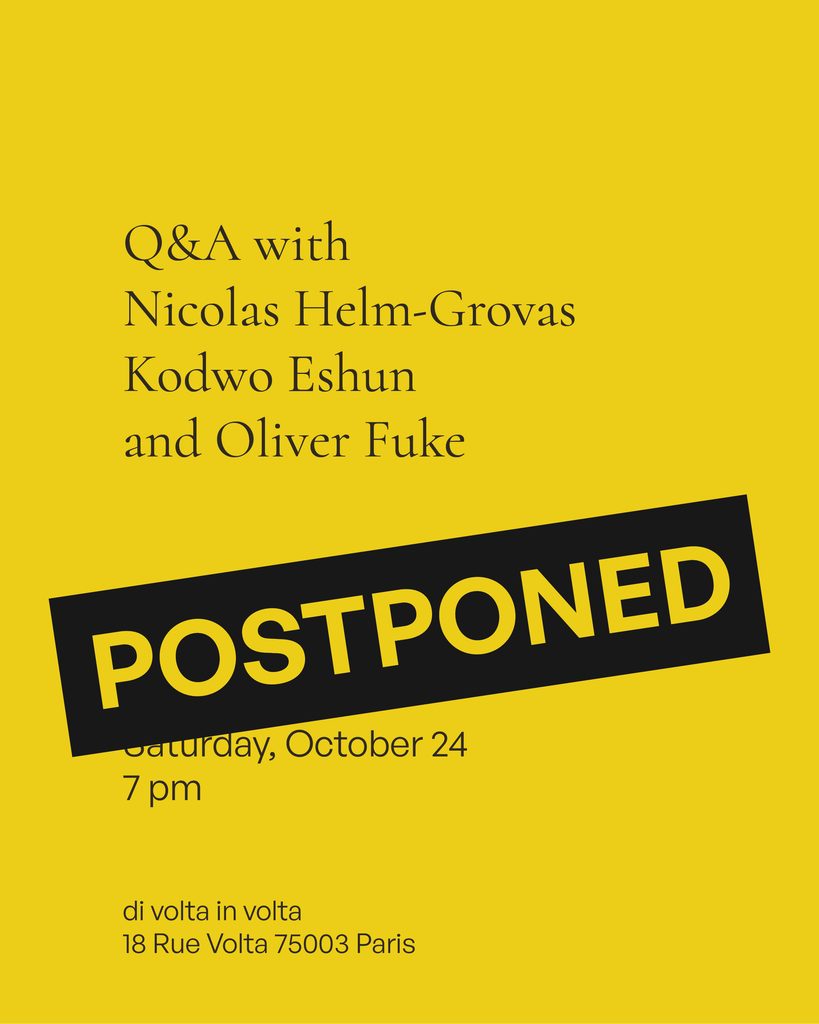
Press release (10/22/2026):
Act II of the October 17 mobilizations will take place this Saturday, October 24, 2026, at the call of the Yellow Vests coordination group and high school and university student organizations.
As a space for critical reflection and dialogue between theories of the contemporary and imperialism, the seminar What Is to Be Done with the Contemporary? cannot remain disconnected from the ongoing mobilizations against the rising cost of living and for dignified conditions of education.
By mutual agreement, the event scheduled for that day with Nicolas Helm-Grovas, Kodwo Eshun, and Oliver Fuke, co-editors of Peter Wollen’s Arrows of Desire: Selected Writings 1963–2002, will therefore not be maintained and has been postponed sine die.
Further information will be shared soon. In the meantime, let’s gather this Saturday at the demonstrations.
*
Communiqué (22/10/2026) :
L’acte II des mobilisations du 17 octobre aura lieu ce samedi 24 octobre 2026, à l’appel de la coordination des gilets jaunes et d’organisations lycéennes et étudiantes.
En tant que lieu d’élaboration critique et de dialogue entre les théories du contemporain et de l’impérialisme, le séminaire Que faire du contemporain ? ne peut rester déconnecté des mobilisations en cours contre la vie chère et pour des conditions dignes d’apprentissage.
D’un commun accord, la rencontre prévue ce jour-là avec les co-éditeurs du livre Arrows of Desire: Selected Writings 1963-2002 de Peter Wollen, Nicolas Helm-Grovas, Kodwo Eshun et Oliver Fuke, n’est donc pas maintenue et reportée sine die.
Plus d’informations seront communiquées prochainement. D’ici là, retrouvons-nous samedi aux manifestations.
Announcement (09/10/2026):
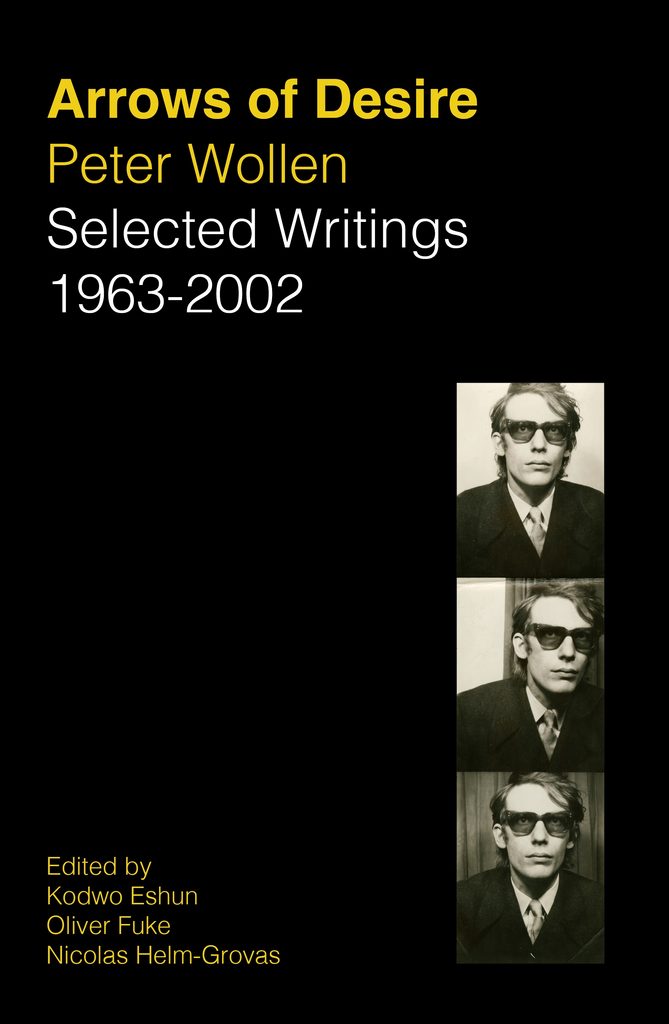
On Saturday, October 24, 2026, the seminar What Is To Be Done with the Contemporary? will be pleased to welcome Nicolas Helm-Grovas, Kodwo Eshun, and Oliver Fuke, co-editors of a new anthology of writings by Peter Wollen, Arrows of Desire: Selected Writings 1963–2002 (Verso, 2026).
This session will focus on this editorial project and explore Peter Wollen’s work through a Q&A discussion, taking place at 7 p.m. at 18 Rue Volta, 75003 Paris. The event will be open to all, subject to availibility.
It will follow the first two sessions of the seminar, held last June: a talk by Peter Osborne, the transcript of which is now available online here, and a roundtable discussion organized by Sophia Djitli, with François-Xavier Hutteau and Hugo Souza de Cursi, with more details there.
An introduction to the seminar is also available here, and further sessions will soon be announced.
Presentation:
Arrows of Desire is the first volume of a forthcoming trilogy bringing together previously unpublished writings by Peter Wollen on ‘counter-cinema’, the politics of anti-imperialism, and revolutionary Mexican art. It includes texts on Sergei Eisenstein and Jean-Luc Godard, alongside essays and interviews tracing developments in film and video from the 1970s to the 1990s. In doing so, it seeks to situate the idea of a ‘counter-cinema’ within a longer historical durée, echoing the curatorial montage strategies Wollen employed in organizing Arrows of Desire, the Second Independent Film and Video Biennale at the ICA in 1992.
Relatively little known, this project lends its title to the book, which aims, among other things, to ‘defamiliarize’ Wollen’s work, itself seeking to produce effects of estrangement for the reader or viewer. The presentation of texts on Iran, Indonesia, Palestine, Aden, Zanzibar, and the United Kingdom, as well as writings related to the film Friendship’s Death (1987)—adapted from Wollen’s 1976 science-fiction story about an extraterrestrial android who lands in Amman, Jordan, a few days before the events of ‘Black September’—shows how Wollen’s cinema unsettles dominant representations while drawing on his experience as a journalist. These writings testify to his search for a vocabulary capable of articulating domestic contradictions and international conflicts in the analysis of British and American imperialisms, as well as questions of larceny, debt, and recognition in the history of American art.
The book thus presents preparatory ‘avant-texts’ for an unrealized exhibition project, The Continent (1992–93), which sought to foreground American art’s debt to the Mexican muralists and to challenge the Eurocentrism and androcentrism of Western culture. It examines their potential and use value in the present, while also considering the afterlives of realized projects such as the exhibition Frida Kahlo and Tina Modotti (1982), organized with Laura Mulvey, which reconsidered the historical forms of the Mexican avant-garde in light of the political questions raised by the feminist avant-garde; or the North American section curated by Wollen for the exhibition Global Conceptualism: Points of Origin, 1950s–1980s (1999), which challenged the canon of conceptual art, understood as part of an edifice of American modern art structured by logics of surrogation and suppression.
The session will revisit the curatorial and cinematic counter-strategies explored by Peter Wollen through a dialogue between the theoretical analysis of the ‘intermedial ontology of film’ and the ‘montagic staging’ of exhibitions. In particular, we will discuss the notion of a ‘montage of politics’, presented by the book as a means of articulating politics of identity and the politics of the personal with Marxism and the politics of socialism. While it situates its readers in the early 1990s, in the Britain of Prime Minister John Major—Margaret Thatcher’s Conservative successor—on the threshold of a triumphant neoliberal globalization, we will also return to its foregrounding of Peter Wollen’s sustained commitment to anti-imperialist and internationalist politics.
Speakers:
Nicolas Helm-Grovas is a writer and a researcher working on film theory, experimental and radical cinema, critical theory and contemporary art, and an Affiliate Fellow at ICI Berlin Institute for Cultural Inquiry. He is the author of Laura Mulvey and Peter Wollen: Towards Counter-Cinema (Brill, 2026), and his writing has appeared in publications such as Oxford Art Journal, Discourse, Radical Philosophy and New Left Review: Sidecar. He is currently editing and translating a book of essays by the Spanish artist María Ruido, titled Sex and the Factory, which will be published by b_books in 2027.
Dr. Kodwo Eshun lectures at the Centre for Research Architecture at the Department of Visual Cultures, Goldsmiths, University of London. He is author of More Brilliant than the Sun: Adventures in Sonic Fiction and Dan Graham: Rock My Religion, co-editor of Post Punk Then and Now, Harun Farocki: Against What? Against Whom? and The Ghosts of Songs: The Film Art of the Black Audio Film Collective 1982–1998 and co-founder of the award-winning Otolith Group.
Oliver Fuke is an independent researcher. His projects include: Beyond the Scorched Earth of Counter-Cinema (2016); The Films of Laura Mulvey and Peter Wollen: Scripts, Working Documents, Interpretation (2023); Trevor Mathison: From Signal to Decay: Volumes 1-6 (with Appau Jnr Boakye-Yiadom, 2022-23); Sammy Baloji (2024-25); Paper Tiger Television: It’s 8:30. Do you know where your brains are? (2026); and Selected Writings of Teshome H. Gabriel: Third Cinema, Nomadic Aesthetics, and Storytelling (with Vinay Lal, 2027).
About Peter Wollen:
Peter Wollen (1938-2019) was a cultural critic, film theorist, curator, professor, journalist, and avant-garde filmmaker. His books include Signs and Meaning in the Cinema (Secker and Warburg, 1969), Readings and Writings: Semiotic Counter-Strategies (Verso, 1982), Singin’ in the Rain (BFI Publishing, 1992), Paris Hollywood: Writings on Film (Verso, 2002), Paris Manhattan: Writings on Art (Verso, 2004), and Raiding the Icebox: Reflections on Twentieth-Century Culture (Verso, 2008).
He co-wrote the screenplay for Antonioni’s The Passenger (1975), and subsequently co-wrote and co-directed six films in collaboration with Laura Mulvey, including Penthesilea: Queen of the Amazons (1974) and Riddles of the Sphinx (1977). His final film was a solo project, Friendship’s Death (1987), starring Tilda Swinton. He also curated the exhibition Frida Kahlo and Tina Modotti (with Laura Mulvey, 1982), and On the Passage of a Few People through a Rather Brief Moment in Time: The Situationist International, 1957-1972 (with Mark Francis, 1989).
He wrote numerous articles and essays for independent magazines and journals, including New Left Review, Screen, Framework, and Afterimage, among them ‘Godard and Counter-Cinema: Vent d’Est’ (1972) and ‘The Two Avant-Gardes’ (1975). He taught film theory at many universities in Europe and in the United States, where he was Professor of Film in the Critical Studies Program of the Film Department at the University of California, Los Angeles.
The forthcoming anthology of his writings, co-edited by Nicolas Helm-Grovas, Kodwo Eshun, and Oliver Fuke, will be published by Verso in three volumes: Arrows of Desire: Selected Writings 1963-2002, Knights Moves: Selected Writings 1966-2003, and Fire and Ice: Selected Writings 1960-2004.
*
Le samedi 24 octobre 2026, le séminaire Que faire du Contemporain ? aura le plaisir d’accueillir Nicolas Helm-Grovas, Kodwo Eshun, et Oliver Fuke, les co-éditeurs d’une nouvelle anthologie de textes de Peter Wollen, ‘Arrows of Desire: Selected Writings 1963-2002’ (Verso, 2026).
Cette séance sera dédiée à ce projet éditorial et s’intéressera à l’œuvre de Peter Wollen, en prenant la forme d’une conversation qui aura lieu à 19 h au 18 Rue Volta, 75003 Paris. Elle sera ouverte à toutes et à tous, sous réserves des places disponibles. Compte tenu de l’espace limité, un rsvp est recommandé.
Elle fera suite aux premières séances qui ont eu lieu au mois de juin dernier: l’intervention de Peter Osborne, dont la transcription est désormais en ligne ici, et la table ronde organisée par Sophia Djitli, avec François-Xavier Hutteau et Hugo Souza de Cursi, avec plus d’informations ici.
Une présentation du séminaire est également disponible ici. Les séances à venir seront bientôt annoncées.
Présentation de la séance :
Arrows of Desire est le premier volume d’une trilogie à paraître qui rassemble des textes inédits de Peter Wollen sur le “contre-cinéma”, les politiques de l’anti-impérialisme, et l’art mexicain révolutionnaire. Il présente des textes sur Sergueï Eisenstein et Jean-Luc Godard, aux côtés d’essais et d’interviews retraçant des développements du film et de la vidéo des années 70 aux années 90. Il propose ainsi d’articuler l’idée d’un “contre-cinéma” à une plus longue durée, en faisant écho aux stratégies de montage curatoriales mises en place par Wollen dans l’organisation d’Arrows of Desire, la seconde Biennale du film et de la vidéo indépendants à l’ICA, en 1992.
Relativement moins connu, ce projet prête son titre à l’ouvrage qui vise notamment à “défamiliariser” l’œuvre de Wollen, cherchant elle-même à produire des effets de distanciation sur le lecteur ou le spectateur. La présentation de textes sur l’Iran, l’Indonésie, la Palestine, Aden, Zanzibar, et le Royaume-Uni, et d’écrits en lien avec le film Friendship’s Death (1987) — adapté d’un récit de science-fiction écrit par Wollen en 1976 et mettant en scène une androïde extraterrestre atterrissant à Amman, en Jordanie, quelques jours avant les évènements de “Septembre noir” — montre comment le cinéma de Wollen déstabilise les représentations dominantes, tout en puisant dans son expérience de journaliste. Ces écrits témoignent de sa recherche d’un vocabulaire permettant d’articuler contradictions domestiques et conflits internationaux dans l’analyse des impérialismes britannique et américain, de même que des questions de vol, de dette et de reconnaissance dans l’histoire de l’art américaine.
Le livre présente ainsi des “avant-textes” préparatoires d’un projet d’exposition non réalisée, The Continent (1992-3), qui visait à mettre en avant la dette de l’art américain envers les muralistes mexicains et à s’attaquer à l’eurocentrisme et à l’androcentrisme de la culture occidentale. Il en interroge les potentiels et la valeur d’usage dans notre présent, tout en s’intéressant à l’héritage de projets réalisés, tel que l’exposition Frida Kahlo and Tina Modotti (1982) organisée avec Laura Mulvey, qui interrogeait les formes historiques de l’avant-garde mexicaine à l’aune des questions politiques soulevées par l’avant-garde féministe, ou la section nord-américaine de l’exposition Global Conceptualism: Points of Origin, 1950s–1980s (1999), dont Wollen assurait le commissariat, qui s’attaquait au canon de l’art conceptuel, compris dans un édifice de l’art moderne américain basé sur des logiques de substitution et d’effacement.
La séance reviendra sur les contre-stratégies curatoriales et cinématographiques expérimentées par Peter Wollen à travers le dialogue entre l’analyse théorique de “l’ontologie intermédiale du film” et “la mise en scène par montage” de l’exposition. Nous discuterons en particulier de la notion de “montage des politiques” présentée par le livre comme un moyen d’articulation des politiques de l’identité et des politiques du personnel au marxisme et aux politiques du socialisme, tandis qu’il situe les lecteurs·rices au début des années 90, dans l’Angleterre du premier ministre John Major — successeur conservateur de Margaret Thatcher — au seuil d’une globalisation néolibérale triomphante, et met en avant l’engagement continu de Peter Wollen envers les politiques anti-impérialistes et internationalistes.
Intervenants :
Nicolas Helm-Grovas est auteur et chercheur, spécialisé dans la théorie du cinéma, le cinéma expérimental et radical, la théorie critique et l’art contemporain. Il est également chercheur associé à l’ICI Berlin Institute for Cultural Inquiry. Il est l’auteur de Laura Mulvey and Peter Wollen: Towards Counter-Cinema (Brill, 2026), et ses écrits ont notamment été publiés dans des revues telles que Oxford Art Journal, Discourse, Radical Philosophy et New Left Review: Sidecar. Il travaille actuellement à l’édition et à la traduction d’un recueil d’essais de l’artiste espagnole María Ruido, intitulé Sex and the Factory, qui paraîtra chez b_books en 2027.
Kodwo Eshun enseigne au Centre for Research Architecture, au sein du département des cultures visuelles de Goldsmiths, University of London. Il est l’auteur de More Brilliant than the Sun: Adventures in Sonic Fiction et de Dan Graham: Rock My Religion, et a co-dirigé les ouvrages Post Punk Then and Now, Harun Farocki: Against What? Against Whom? et The Ghosts of Songs: The Film Art of the Black Audio Film Collective 1982–1998. Il est également cofondateur de l’Otolith Group, collectif artistique récompensé.
Oliver Fuke est chercheur indépendant. Parmi ses projets figurent Beyond the Scorched Earth of Counter-Cinema (2016), The Films of Laura Mulvey and Peter Wollen: Scripts, Working Documents, Interpretation (2023), Trevor Mathison: From Signal to Decay: Volumes 1–6 (avec Appau Jnr Boakye-Yiadom, 2022–2023), Sammy Baloji (2024–2025), Paper Tiger Television: It’s 8:30. Do You Know Where Your Brains Are? (2026) et Selected Writings of Teshome H. Gabriel: Third Cinema, Nomadic Aesthetics, and Storytelling (avec Vinay Lal, 2027).
À propos de Peter Wollen :
Peter Wollen (1938–2019) était critique culturel, théoricien du cinéma, commissaire d’exposition, professeur, journaliste et cinéaste d’avant-garde. Parmi ses ouvrages figurent Signs and Meaning in the Cinema (Secker and Warburg, 1969), Readings and Writings: Semiotic Counter-Strategies (Verso, 1982), Singin’ in the Rain (BFI Publishing, 1992), Paris Hollywood: Writings on Film (Verso, 2002), Paris Manhattan: Writings on Art (Verso, 2004) et Raiding the Icebox: Reflections on Twentieth-Century Culture (Verso, 2008).
Il a coécrit le scénario de The Passenger (1975) de Michelangelo Antonioni, avant de coscénariser et coréaliser six films avec Laura Mulvey, dont Penthesilea: Queen of the Amazons (1974) et Riddles of the Sphinx (1977). Son dernier film, Friendship’s Death (1987), avec Tilda Swinton, est une réalisation personnelle. Il a également été commissaire des expositions Frida Kahlo and Tina Modotti (avec Laura Mulvey, 1982) et On the Passage of a Few People through a Rather Brief Moment in Time: The Situationist International, 1957–1972 (avec Mark Francis, 1989).
Il a écrit de nombreux d’articles et d’essais pour des revues et publications indépendantes, notamment New Left Review, Screen, Framework et Afterimage, parmi lesquels “Godard and Counter-Cinema: Vent d’Est” (1972) et “The Two Avant-Gardes” (1975). Il a enseigné la théorie du cinéma dans de nombreuses universités en Europe et aux États-Unis, où il a occupé un poste de professeur de cinéma au sein du programme d’études critiques du département de cinéma de l’Université de Californie à Los Angeles (UCLA).
Une anthologie de ses écrits en trois volumes, codirigée par Nicolas Helm-Grovas, Kodwo Eshun et Oliver Fuke, paraîtra prochainement chez Verso. Elle comprend Arrows of Desire: Selected Writings 1963–2002, Knights Moves: Selected Writings 1966–2003 et Fire and Ice: Selected Writings 1960–2004.